Saturday, 5 April 2014

12. Scarborough
       C&CC Site
       April 2nd - 4th

A short journey, again of around forty miles and again not much to speak of. The AA Routefinder instructions seemed to bear no relation to the real world and I found the site in spite of them, coming at it from the opposite direction. It's rather a sad site, rather scruffy. Huge open spaces, dotted with six big ochre-painted buildings, a women's toilet block, a recreation block, a men's toilet block, three more of them, unidentified. The hard-standings are, in fact, grass with plastic honeycomb mats, perfectly serviceable but scruffy. Few trees. The whole place has the atmosphere of a second-rate holiday camp and the depressing feel has been made worse by a blanket of sea-mist which has hung overhead, almost touchable, since I arrived. The bus service which used to stop outside the gate has been discontinued because a subsidy has been withdrawn. I feel guilty about whingeing like this; it's only £12 a night, I'm only here for three nights and I'm warm and the staff are friendly and helpful.

At midday as I drove along the MP3 was playing 'On the Road Again' by Canned Heat. Honestly.

A small gnome-like old man is next to me, complete with small, un-gnome-like old wife. They have a tiny caravan and a huge car., the first instance I have seen of a car bigger than the caravan it tows. He stares, but then looks away when you try to say 'hello'. Further on is a couple with a motor-home and a savage-looking hairy Alsatian, which seems to sleep in its own tent. It went a bit postal when it saw me returning from my shower and it was, for a minute, frightening when I thought it was off its lead (streng verboten on all club sites). It was, in fact, tied to a peg and was quite harmless. I'm a bit fragile in the mornings.
 
I watched the second part of 'Shetland' on Tuesday night. I like Ann Cleeve's books (she also writes the police detective novels from which ITV made the 'Vera' series with Brenda Blethyn. Douglas Henshall, who plays the Shetlander police detective Jimmy Perez, a descendant of a Spanish Armada survivor, is always good. My enjoyment was spoiled, though, because I could understand barely a word. Henshall had turned-up his accent to full-bore and his young lady assistant Tosh (who I can't remember in the books) was incomprehensible. It's good to be realistic, but not at the expense, surely, of transparency. Perhaps when Scotland becomes independent we will get sub-titles on TV programmes with Scottish actors.

On Thursday I walked down to the 'Ivanhoe' pub to get the No. 3 'bus, ' Sea-Life Centre to Town Centre'. I had discovered that the site used to be Scalby Manor Caravan site, so I guess the Club must have bought it as a going concern. This is probably why it lacks the cosy warm cuddly feeling you get with both Clubs' sites. I walked past Scalby Manor, now a Hungry Hippo eatery or something (“Sorry, pub closed until Fri”)(Fish and unlimited chips £6-50), down over Scalby Beck where it falls over a pretty weir and up to the pub. No sign of a bus stop or timetable. I asked a man walking a friendly yellow labrador, but he was so unfriendly himself and wouldn't even stop to tell me he knew 'bugger all about 't booses'. The Yorkshire accent often makes men sound like surly thugs; or perhaps this particular ray of sunshine was a surly thug. Mmmm. I carried on walking to town and found a stop complete with friendly old lady who had a chat.

The bus goes past the North Bay Amusement Park (rather fetching with a miniature railway set in pine woods) and Peasholm Park, very attractive. All quite Bournemouth and very encouraging. It also has 'Europe's Biggest Open-Air Theatre'. There were lots of seats arranged in a sort of amphitheatre, but no apparent stage. In front of the seats, where a stage normally belongs, was a lake. I was rather puzzled. Do they board over the lake when there is a performance, or do the actors perform from boats or pontoons floating on the lake or do they declaim whilst swimming?

As we entered the town I noticed that Scarborough is twinned with Cahir in Tipperary in Ireland. I've never seen an English town twinned with a Irish one. We passed a cinema so battered and ruined-looking that it called to mind the hotel in Belfast (the Europa?) which was the most bombed building in Northern Ireland (or was it the universe?). Amazingly, it was alive and well and showing three of the latest films.

I saw a 'J' reg. (1991) Hymer camper van on a Talbot chassis, the oldest Hymer I've even seen and a venerable old lady in very nice condition. The A165 into town is lined with boarding houses, five-storey terraces a bit like the old Edinburgh lands. The population must double in the summer.

A nice old gent on the bus directed me to the station; he was so solicitous that at one point I thought he was going to come with me. The station is a fine solid almost fascist piece of architecture (but not in the same league as Milan station) with a handsome glass roof. Nearly all the trains seemed to go to Liverpool Lime Street. Very curious. Opposite it is the Stephen Joseph theatre, previously the massive Art Deco Odeon cinema, where Alan Ayckbourn’s plays are staged. He still lives in Scarborough, but I notice he was born in London and went to prep school in Wisborough Green near Horsham.


In the main street a shaven-headed brute in a 'Help the Heroes' hoodie was talking to a mate in a loud Yorkshire-thug voice using, in the main, one word - “fookin'”. I decided to tell him he was giving the charity a bad name but then, for some reason, I decided not to. Was he ex-Army? Had military training made a brute of him? The Army was recruiting just up the street. Some squaddies who looked to me to be twelve years old were strolling around in desert camouflage fatigues. Had he entered service from school like one of them and become the brute he is now? We'll never know.


Pondering these imponderables, I went on to Tesco's, a vast building which seems to be built on the edge of a cliff (Scarborough is very hilly). Among all the usual groceries I got a bulb of fennel which I'm going to braise to-night. I love fennel.

The Station


The whole town was redolent of fried fish and chips. Very tempting and not surprising as I gave up counting fish and chip shops when I got into double figures. I think I will probably succumb tomorrow. I wonder what cod and chips is called here. In some places it's called 'fish and chips', in some 'cod and chips' (way too obvious) and in some 'a fish lot'. 'A fish parcel' sounds familiar too. Only one way to find out. Tomorrow is another day.

As I write Judy Collins is singing Leonard Cohen's song 'Priests'. I think this is his greatest song, but (and I may be wrong) he never recorded it himself.

“And all of you have seen the dance
                           That God has kept from me”
 
Now that is a sad line. It out-Cohens Cohen. Never listen to Leonard Cohen when you're on your own, Rog. Well, I know, but it's just the way the MP3 player churns them out, Rog, you don't know what's coming next.

I've just remembered listening to a programme on Radio 4 the other day about micro breweries (or 'craft breweries' as they seem to call them now). I was only half-listening when a bloke mentioned Michael Jackson and the role he had played in the resurgence of proper beer. I had a surreal moment. Michael Jackson? Then I remembered another Michael Jackson had been a major figure in CAMRA. Quite disappointed.

Harbour mouth
 My last day dawned – yes, you guessed it – cold and misty. Undaunted, I cycled down to the Sea-Life Centre and then from North Bay right down to the harbour, about 8 miles there and back. No cycle paths anywhere, not a single one . The only reference to cycling was a sign saying 'NO CYCLING' at the start of the promenade. I saw only three other cyclists the whole time I was out and one of those was an Über-cyclist clad in head-to-toe Lycra and doing about ninety mph. The harbour was nice, with a mixture of leisure craft and fishing boats. The boats were just coming in while I was watching at the end of the jetty at the harbour mouth. From there you can look back across South Bay at the beach and the seafront. The lighthouse at the harbour mouth is now the Scarborough Yacht Club – 'Private, Members Only'. There is an enormous hotel on the cliff looming
over the beach.                                                                                                                     Scarborough seems to go in for large buildings.  


When the boat comes in............


Wednesday, 2 April 2014

11. York
      CC site
      30th March-1st April

Over the Humber Bridge - £1-50 toll and worth every penny. What a great bridge, towering over the Humber Estuary just west of Hull. The river is very wide even here. Lots of people walking across the bridge, taking their Sunday constitutionals. More scenery here on the bridge than anywhere else around here.

New Feature
From now on I'm going to tell you what my MP3 player was playing at 12:00 on the road each time I move sites (I hook it up to the van stereo). And to-day it was 'Mother's Little Helper' by the Rolling Stones.

Not much to say about the journey (about 40 miles). I think it's through the Wolds; certainly the road undulated in a woldish sort of way. More trees and hedges. The site is about 3 miles from York and is set on a stud farm. The two mares looked to my untutored eye like racehorses and were beautiful chestnuts.

Sat in the Sunday afternoon sun and read my book. On Monday I cycled to the Park and Ride and caught the bus to the city. Now, anyone who knows me will not be surprised to learn that my first target was the National Rail Museum.

This is just so magnificent that I felt I was floating on air. When you enter the main hall there is a strong but delicate scent of machine oil which turns the head as not even the finest perfume could. I think the last time I was here was about 35 years ago; it was great then but it's improved. Can it get any better? I'm not going to bore you with the minutiae of steam locomotives, but here are a few tit bits.


In the cab of 'Evening Star', the last steam locomotive built for British Rail, there are two seats, one for the fireman and one for the driver. The driver's is padded, while the fireman's is wooden (albeit carved to fit a bottom); a pecking order, always a pecking order.

The ex-GWR 'King' class express engine never reached its full potential speed because a single fireman couldn't keep up with its appetite for coal. ('GWR' is short, by the way, for 'Great Western Railway', but railway aficionados (a.k.a. train spotters) regard it as the paragon of railways and accordingly call it 'God's Wonderful Railway'.

The EM1 electric locomotive, which was designed by Sir Nigel Gresley to haul heavy coal trains over the Pennines because the crew of steam engines on that line used to pass-out from smoke suffocation in the Woodhead Tunnel, was made from re-cycled military tanks.

In a section called 'The Warehouse' is an enormous collection of railway bric-a-brac; station name boards (including Llanfair PG), locomotive name plates ('Marmion', 'King George V', 'Christ's Hospital') , express train head boards ('The Master Cutler', 'The Irish Mail', 'The Atlantic Coast Express'), lamps, signalling equipment, stained glass windows from station waiting rooms, and on and on and on. What caught my eye, though, was a huge number of models and rolling stock of all scales labelled with such detail as “Built by Mr Arnold Bulbtoilet, 1949-1956 and donated to the Museum by his family”. How nice.
 
Royal York Hotel
There was a horrifying exhibit devoted to crashes, including the celebrated Tay Bridge Disaster of 1879 which brought to the world the sublime poet William McGonagall. The peak of his poetic achievement is “The Tay Bridge Disaster”

Beautiful Railway Bridge of the Silv'ry Tay!
Alas! I am very sorry to say
That ninety lives have been taken away
On the last Sabbath day of 1879,
Which will be remember'd for a very long time.

And so on..........

 I was there for four hours and it seemed like 4 minutes. And it was free! Of course, I made a small donation. Again I noticed that, as Paul Theroux said, everyone around old steam trains walks around with a gentle smile on their face.

York itself has so many attractions. The narrow mediaeval streets, the city walls, the seductive dark old pubs, the river (Ouse) and, of course the Minster. Who could but love a city which has a street called 'Whip-Ma-Whop-Ma Street'? I saw the end wall of a terrace of houses on which was painted the advertisement 'Nightly Bile Beans keep you bright-eyed, health and slim'. Was it an original? Is there anyone alive who took Bile Beans? What were they?
 
Some English Kings (and old ladies)

The next day I went in again, this time to see the Minster. There was a serious fire a few years ago, but the damage seems to have been repaired. I had a nice chat on the bus with a lady who came from Newcastle but who moved to York twenty-five years ago. We were both singing the city's praises, and the only negative she could think of was the tourists. “They do get under your feet a bit”, she said. They certainly do; they were queuing outside Betty's Tearooms and it's only April .

For me the best bit of any cathedral is the choir, but at York I love the Astronomical Clock. There is also a superb collection of carvings of the kings of England from William the Conqueror right up to Henry VI. There is a strong family resemblance between many of them, but I suspect that it's just that the sculptor had a limited repertoire of faces.  
 
The Choir

I was glad to see the Royal Station Hotel still in its splendour, although it has been re-named “The Royal York Hotel”. I stayed there for a happy weekend treat with my family thirty-odd years ago and it was like being in another world and another century. I remember I managed to flush my contact lenses down the drain in the bathroom.

Cycling past the farm next to the site on the way to the Park and Ride I had seen a fox and a pheasant in the farmhouse's front garden, standing facing each other, twenty-five feet apart and totally motionless. I watched for a bit but I was concerned for the pheasant’s welfare and tried to startle them by clapping my hands. No response, I tried again. So I wrote the pheasant off as either deaf or daft and in either case deserving removal from the gene pool and carried on cycling. When I returned, the pheasant had fallen over but the fox was still staring at it. I couldn’t resist and cycled up the drive to take a closer look. Of course, you guessed it, they were made of plastic. The pheasant had simply blown over. Doh! The first thing I did was to look all around me to make sure nobody had seen me. I thought I did hear sniggering coming from somewhere though. 

I very much enjoyed the first episode of the new “Endeavour” series on Sunday night. If you don't know, it's about the young Morse. He's a much more attractive character (he's not always on the pull every week for a start) and is a much better detective than his older self. I spotted a great little clip. At one point he goes to visit someone and stands at the door in front of an array of brass nameplates with bells. The bottom one says “R. Duck”. Ah-ha, Raymond Duck, from “Withnail and I”, Uncle Monty's theatrical agent. 'Raymond Duck, a horrible little Israelite, four floors up on the Charing Crorss Road and no job at the top '. Someone's having a laugh! Marvellous!

And so it's farewell to York, a civilised place.   
 

                                                               A fox and a pheasant


Tuesday, 1 April 2014

10. Barrow-upon-Humber
       Private site
       27th-29th March

60 mile drive up the A15 from Lincoln. The road, which was dead-straight, was the Roman Ermine Street, which went from London to Lincoln, the Humber and York. The only noteworthy feature was the number of places ending in “-by”, one of the Danish/Viking place name endings. Among them were several entries in The Meaning of Liffe, including:-

CLIXBY (adj.): Politely rude. Briskly vague. Firmly uninformative

Talking of “-by”, I've been listening to Radio 4 and Simon Russell Beale reading Ben McIntyre's latest book, “A Spy Among Friends” about Kim Philby. As with all McIntyre's books, it's fascinating; he really is the master of studies of espionage, a subject which I find absolutely absorbing. In hindsight it's difficult to understand how members of a privileged middle-class elite like Burgess, McLean, Philby and Blunt could have been so utterly captivated by communism. There was, of course, idealism (Philby is quoted as saying “the rich have oppressed the poor for too long”) but they must have seen the monster's true colours when Stalin's Five Year Plan and his purges killed millions in the Twenties and Thirties and when he signed a non-aggression pact with Hitler in 1939. Of course there was “the end justifies the means” school of thought, but so many others left the party after these revelations that it's impossible to understand how these golden children could have overlooked such horrors. And then there was the personal betrayal of friends and family and the terrible fate of hundreds of agents throughout Europe as a result of the treachery of Philby in particular. I suppose he was Bill Haydon in le Carré's Tinker, Tailor, Soldier, Spy. At the end, Smiley's wife says something along the lines of “Bill betrayed totally, absolutely, didn't he?” and it's easy to imagine, for example, Philby's loyal friend and disciple Nicholas Elliott uttering this terribly sad postscript. Simon Russell Beale is a wonderful reader, by the way.

I've just noticed there's a place called Bessacarr on the outskirts of Doncaster. There's a caravan and motorhome manufacturer called Bessacarr. For some obscure reason I had always thought these were French but now I see they are much more exotic.

Radio Four Extra is broadcasting some old 1970's issues of Alastair Cooke's Letter from America starting on Sunday morning. The preview has him reviewing Watergate and Nixon. Should be fascinating.

Blimey, I've just heard on the radio that cats have been giving people the strain of TB found in cattle. Perhaps the badgers were innocent after all. Is a cull of cats next? There's a few votes down the drain if Dave goes for that.

I came to Barrow-upon-Humber in search of a particular story (more anon) and was unaware until I got here that the village had a connection with John Harrison, the man who solved the longitude problem. Until his super-accurate chronograph went into service, it had been possible for navigators to pinpoint a ship's position north-south (its latitude) but not its position east-west (its longitude). In 1707, 2,000 Royal Navy sailors under Admiral Sir Cloudesley Shovell were lost off the Scilly Isles because of this problem and Parliament offered a prize of £20,000 for a solution. Harrison's family moved to Barrow when he was seven and he worked as a carpenter and watchmaker there for 58 years in a workshop close to the market place, developing successively better chronometers. His last design (“H4”) came after his move to London. In a number of sea-trials it fulfilled Parliament's requirements but Harrison had to petition the King (George III) to get his money. (It seems that Parliament was a nest of vipers then, too. They probably wanted to spend the money on duck islands). The story of Harrison and the longitude problem is told in Dava Sobel's excellent book “Longitude”.

But now the main story. I'm a great admirer of Paul Theroux's travel books, written over, I guess, a thirty year period. I first read “The Great Railway Bazaar: By Train through Asia” in around 1980. In it he meets a man called Duffill whom he describes thus:-

“He was old and his clothes were far too big for him, so he might have left in a hurry and grabbed the wrong clothes, or perhaps he's just come out of the hospital. He walked treading his trouser cuffs to rags and carried many oddly shaped parcels wrapped in string and brown paper – more the luggage of an incautiously busy bomber than of an intrepid traveller. The tags were fluttering in the draught from the track, and each gave his name as R. Duffill and his address as Splendid Palas Hotel, Istanbul.”

(Now, before I go any further I'm going to tell you the lesson I learned from the story, so you can see what an important story it is and so that you continue right to the end, however distant and obscure that end might seem. The lesson is never to judge anyone by their appearance. It was wonderful to see the vile Simon Cowell learn this lesson when Susan Boyle began to sing).

They travel together as far as the French/Italian border, Theroux from time to time describing Duffill's frailty and advanced age. At Domodossola on the France/Italy border Duffill is left behind by the departing train after he has gone to get some food. With another passenger, Theroux does all he can for him, leaving his belongings with the station master at Venice, but he is not seen or heard from again in the book.

In 1982 Theroux undertook a journey around the coast of Britain, mainly by train, and wrote about it in “The Kingdom by the Sea”. It's a wonderful evocation of our strange country at the time of the Falklands War. At some point, Duffill had let slip that he came from Barrow-on-Humber in Lincolnshire, and Theroux goes there to find him. He finds that Duffill had died two years earlier, but he meets his brother Jack's wife and she tells him about him.

'His name was Richard Cuthbert Duffill. He was a most unusual man,' said his sister-in-law........................ He had been as old as the century – seventy-three the year he had stepped off the Orient Express at Domodossola. She asks 'Do you know about his adventurous life?'

I said 'I don't know anything about him.' All I knew was his name and his village.

'He was born right here in Barrow, in the Hall cottages. The Hall was one of the grand houses. Richard's father was the gardener and his mother was a housemaid. ….......of course the Duffills were rather poor.'

But Richard Duffill was brilliant. At the age of eleven he was encouraged by the headmaster of the village school to go to the Technical College in Hull. He excelled at Maths, but he was also a gifted linguist. He learned French, Latin, German, Russian and Spanish while still a teenager at Hull. But he had become somewhat introspective, for when he was twelve his father had died...................

His main recreation was swimming, and his skill in this resulted in his becoming a local hero. One summer day in 1917 he was on a swimming expedition with some friends at a quarry called the Brick Pits, near the Humber Bank. One of the boys, a certain Howson, began to struggle. He shouted, and then he disappeared beneath the murky water. Duffill dived repeatedly after him and finally surfaced with him and dragged him to shore, saving the boy's life. A few days later, the Hull newspaper reported the story under the headline “A Plucky Barrow Boy”.

For this, Duffill – a boy scout – was awarded the Silver Cross for Bravery. It was the first time this honour had ever come to a Lincolnshire scout. Some months afterwards, the Carnegie Heroes' Fund presented Duffill with a silver watch “for gallantry”, and they gave him a sum of money to help him in his education and future career“.  

In 1919, still young, and fluent in half a dozen languages, he joined the Inter-Allied Plebiscite Commission and was sent to Allenstein, in what was then East Prussia, to deal with the aftermath of World War One – sorting out prisoners and helping at the Special Court of Justice. In the following few years he did the same in Klagenfurt and Oppeln (Opole, Upper Silesia – now Poland). Berlin was next. Duffill got a job with the celebrated firm of Price, Waterhouse, the international accountants. He stayed in Berlin for ten years, abruptly resigning in 1935 and leaving – fleeing, some people said – for England.

Politically, he was of the Left. His friends in Berlin thought he might be gathering information for the British secret service. ('One felt he would have made the ideal agent', an old friend of Duffill's told me.) In any case, he left Germany so suddenly it was assumed that he was being pursued by Nazi agents................... He made it safely home, and he was also able to get all his money out of Germany. ('An exceedingly clever and daring feat,' another friend told me. 'His fortune was considerable.').

He may have had a nervous breakdown then; there was some speculation. He sank for a year, re-emerging in 1936 as a chief accountant for an American movie company..................In 1939 there was another gap, lasting until 1945: the war certainly – but where was Duffill? No one could tell me. His brother said, “Richard never discussed his working life or his world-travelling with us.”

In the late forties, he apparently rejoined Price, Waterhouse and travelled throughout Europe. He went to Egypt and Turkey; he returned to Germany; he went to Sweden and Russia, “for whose leaders he had the greatest admiration”.

After his retirement he continued to travel. He had never married. He was always alone. But the snapshots he kept showed him to be a very stylish dresser – waistcoat, plus-fours, cashmere overcoat, homburg, stick-pin............ He wore a rug-like wig.................... He had had brain surgery. He once played tennis in Cairo. He had gone on socialist holidays to eastern Europe. He hated Hitler”.

Theroux discovers that, after being left by the train he had collected his belongings and got to his goal, Istanbul. Mrs Jack had read Theroux's book and had put aside a copy to show Richard, but “ he had his stroke and just deteriorated. And he died. So he never saw it.”

“Thank God for that, I thought”, says Theroux.

I was moved and fascinated by this story and, in a lukewarm sort of way, decided to follow it up. I had been given “The Kingdom by the Sea” for my birthday in 1985, so my resolve was a bit of a slow-burner. But now here I was. The owner of the caravan-site where I stayed at Goxhill a mile or so from Barrow, Ian Briggs-Smith, referred me to a chap called Adrian, who apparently, was “a bit of an historian”. I went into Barrow and left my phone number with Steve, the landlord of the Six Bells, asking Adrian Rawnsley to call me. As I was waiting for the bus I saw Adrian stick his head out of his front door and I went across. He knew who I was because Steve had phoned him. We sat down in Adrian's back room and had a chat and a coffee. Adrian was fascinated by the story. When I said that it taught us not to judge by arrearances, he said something like “Angels walk among us”, which I thought was rather fine. He called another local, Charlie Denniff, who he thought might know more. Adrian, a former teacher who now makes terrariums on the site where John Harrison's workshop had stood, had lived in the village for four years, but Charlie had been born there. Charlie talked about Billy Duffill, who had kept an ironmongers shop in the village and mentioned “Dick Duffill”. Eureka! For some reason I had assumed that “Duffill” was a false name given to him by Theroux. So this was his real name. Both Adrian and Charlie thought that I should talk to Colin Heaton, who was also Barrow-born, and arranged for me to meet him at Charlie's house the following morning.

Colin knew quite a bit, and what he knew corroborated Theroux's story. “He was a small man with a very long coat trailing on the ground”. “When he came back from Istanbul he brought us some Turkish delight, but it was horrible”. The American film company was MGM. Colin also thought that Richard had worked, presumably as an interpreter, at the Nuremberg Trials, but wondered if he had mixed that story up with his work after the First World War. On Saturday nights he used to drink in the other pub, the Royal Oak, with his cronies, among them Sam Hall, the manager of Bentley's, the agricultural supplies company and major local employer, which had closed in 1992. Colin had inherited Richard's father's shotgun, but everything else had been left to his nephew, who had burned all his papers, including a number of pictures and what Colin described as a CV. My heart sank.

I took my leave of these kind, friendly and helpful gentlemen to look for his grave. When I had first got to Barrow I had met a lady in the churchyard who told me that the cemetery was just outside the village. No-one seemed to know where Richard was buried, but that was my only hope. I cycled down there and found quite a large cemetery, perhaps 300/400 graves, and a chapel. I quartered the graveyard in, for me, a surprisingly systematic way, watching in particular for more recent-looking headstones. Some went back to the early years of the last century. After an hour I had almost exhausted all my search areas when I came across a small, dingy rectangular stone, one probably of the last twenty to be examined. And here he was. I knew from the beginning that I would never meet him and I now suspected that I would never see a photograph of him, but at least now, after nearly thirty years, I had found his grave, a connection however tenuous. A simple inscription:-

Richard Cuthbert Duffill
1900 – 1980


(Cuthbert was his mother's maiden name). The simplicity of the stone and the inscription seemed entirely appropriate to what little I knew of him.
Theroux concludes his chapter on Barrow in “The Kingdom by the Sea” with a most wonderful paragraph.

“What an interesting man that stranger had been. He had seemed frail, elderly, a little crazy and suspicious on the Orient Express. Typical, I had thought. But now I knew how unusual he had been – brave, kind, secretive, resourceful, solitary, brilliant. He had slept and snored in the upper berth of my compartment. I had not known him at all, but the more I found out about him the more I missed him. It would have been a privilege to know him personally, and yet even in friendship he would never have confirmed what I strongly suspected – that he had almost certainly been a spy”.

Imagine being able to write like that. But, even better, imagine if someone had written that about you. I don't believe in the afterlife or ghosts or messages from the other side or any of that stuff but I stood at Richard Duffill's grave and read Theroux's moving tribute aloud just in case. And then I set off again on my travels.


Thursday, 27 March 2014

9. Cromwell, near Newark-on-Trent
    CC affiliated site
    24th - 26th March

Wow! I've really fallen on my feet this time. Fabulous site, absolutely fabulous. My pitch overlooks a beautiful lake with lots of wildfowl. £12-50 a night, a gift. Huge pitches, separated by low hedges or, as the brochure puts it “screened by shrubs and boarders”. Went for a bike ride to the village to post some cards and spotted a mountain of beer casks beside the road. I'm next door to a micro-brewery!

It's called the Milestone Brewery and I had a chat with the boss (about 30 years old). He got his equipment from a failed brewery in Ireland and it cost him only £15,000. The big cost, he said, was casks; you need three times your brewing capacity (to allow for cycling the casks) and they cost £50 a piece. 10 years ago he set the whole thing up for £50,000 and now supplies pubs all over the country, including some Wetherspoon's.
He must be brewing now, because there is that lovely smell wafting over the site, just like on Thursdays in Horsham when King and Barnes were brewing. I notice his bottled beer is bottle-conditioned, like Worthington White Shield (i.e. it's got dregs in the bottom). I'll take a couple up to Martin. 

A beautiful sunny day but a bitterly cold wind. Only a 17-mile drive, the last bit up the A1. The site is in Cromwell, a village which used to be on the A1 but which has been by-passed for many years. It looks very prosperous and there is a terrace of very interesting cottages.

                                                          The Governor's House, Newark

Now, here is another rant; something which has really been getting my goat for some time now and on which I must vent spleen. I detest the politically correct tendency to re-write history. Poor old Winston was employed to re-write history in 1984 and that's what the Communists always did and that's what the Bottom Inspectors, in particular the BBC, are doing now. Apparently, we fought the Nazis in WWII and not, after all, the Germans. The German people of my generation have come to terms with the guilt of their fathers' generation and we have all moved on, with the proviso that, as George Santayana said “Those who cannot remember the past are condemned to repeat it. ”. Re-writing this history is as insulting to the new Germans as it is to the victims, the survivors and to their descendants. I'm as glad as the next man that we are all friends now, but I don't like the re-writing of history, the whitewashing of unpleasant facts. It insults me as well. So to-day I was delighted to hear an old chap telling the truth. There is a celebration in Poland of the 70th anniversary of the Great Escape and a BBC newsreader mentioned that the escapers who had been re-captured had been “executed by the Nazis”. A RAF officer who was in the camp at the time but was not one of the escapers was then interviewed and he said that the escapers who had been re-captured had been “murdered by the Germans”. No whitewashing for him.

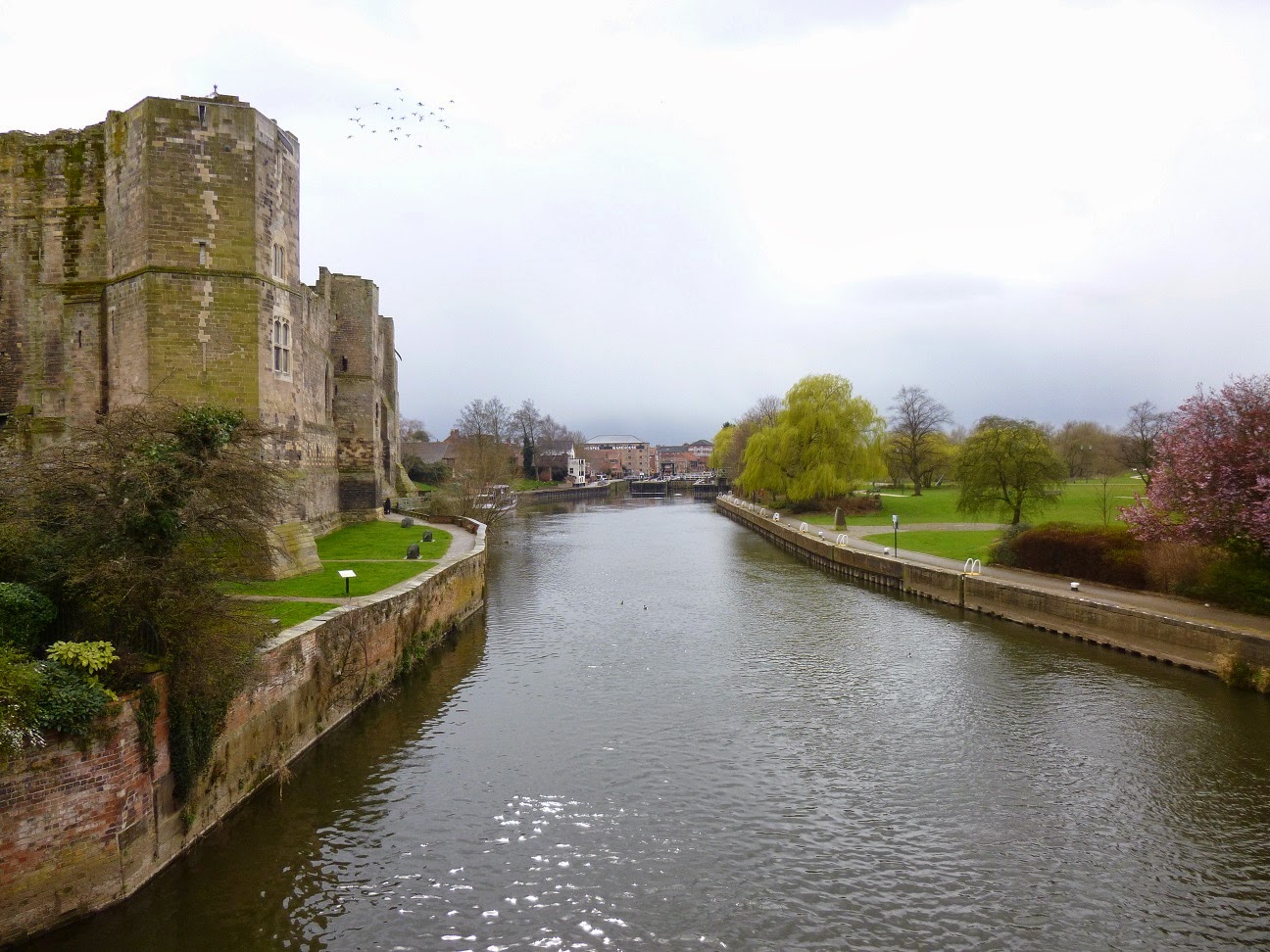
                                                                                              Newark Castle

This morning (Monday) I listened to Professor Jim Al-Khalili's programme “The Life Scientific” on Radio 4. I always enjoy it (he just chats for half an hour to eminent scientists about their lives and work) but to-day's has found a new hero for me. Has anyone heard of Alf Adams? Why haven't we all heard of him? His name should be spoken in the same breath as Newton or Einstein. He invented the type of laser which is in our DVD and CD players, in supermarket check-out readers, in all scanners and in many communications systems - and he had the idea while strolling with his wife on Bournemouth beach! His father, a cobbler and semi-professional boxer, never went to school because he was born with TB. His mother left school at 12. This towering genius made not a penny out of his invention. He was made a Fellow of the Royal Society, but why, when Kissinger and Obama can get the Nobel Peace Prize, has he not been awarded the Physics prize? Read about this astonishing man here:-


Not even a knighthood (what a silly idea the honours system is anyway), surprising when you think that Fred Goodwin and Jimmy Saville were knighted. Still, perhaps he refused one.

Mea culpa, mea maxima culpa. My eagle-eyed daughter Katie has spotted an error in my page about Thetford. I blamed William Cobbold for losing Tom Paine's bones. William who? It was, of course, William Cobbett. Why did I write “Cobbold”? The only Cobbold I know is John Cobbold who was chairman of Ipswich Town Football Club (before the chairman of an English football club had to be a foreign crook). He owned a brewery, so perhaps I was thinking about beer. Well spotted, Katie.

Freezing cold day to-day, but there are some hardy fisherman around the lake. A thorough tour of Newark is needed, especially as it is market day to-day. The photo of the Governor's House is there because it was an important building during the Civil War. It was here that Charles I finally realised that his much-celebrated nephew, Prince Rupert of the Rhine, was a total pillock, after he had lost yet another battle with a gallant cavalry charge against the well-disciplined and battle-hardened New Model Army troops of the Parliamentary army. And another thing; Rupert refused to stop wearing his trademark red jumper and yellow checked trousers. He was also getting fat on Gregg's sausage rolls from downstairs.

The market was enormous. Must have been 50 stalls. I found one which had every tool and item of hardware known to man and bought, for £2, a three-inch long sliding bevel. God knows what I'll do with it, but I found it irresistible.
                                                               A very small sliding bevel

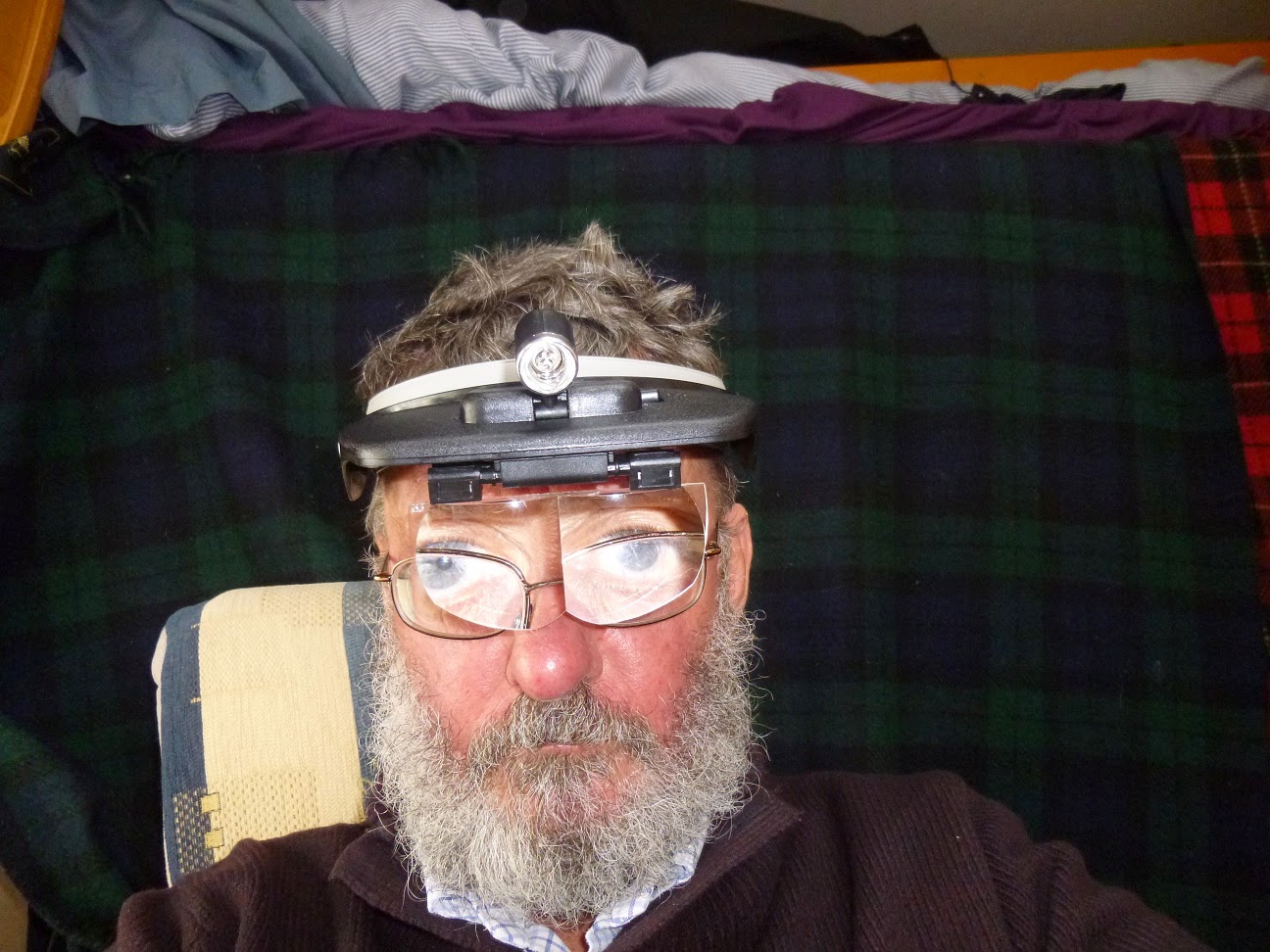
Another thing Newark has going for it is Boyes, a mad small department store, branches of which are in Darlington and Stokesley, where my nephew Martin and his family live. They have a good modelling supplies department with miniature tools, including a tiny brass Archimedes drill, and the full range of Humbrol paints. I bought an illuminated magnifying head band. You might be allowed to see a photo of me wearing it.

I saw very few fatties but quite a few young ladies, and some not so young, who looked like Travellers, with extravagant dress sense, orange complexions, dyed-black hair in cottage-loaf hairstyles, tons of bling and even, on a blisteringly cold day, some bare midriffs. There are many cosy-looking cafés and they all seemed to be packed with middle-aged and old ladies scoffing their heads full. Few men. Perhaps the old ladies have eaten them, too.

The town has a marvellous antiques shop called Gracegentle's, with a superb Gauge 1 model of a Fowler traction engine in the window and it also has a School of Violin Making. Imagine, Newark twinned with Cremona. It also has two railway stations; Northgate, on the East Coast mainline (King's Cross to Edinburgh) and half a mile away, Castle on the line to St. Pancras and serving Grimsby, Leicester, Nottingham and all points north as far as Liverpool.

                                                       An illuminated magnifying headband
The Castle looms over the Trent, which is real man's river here, by the bridge which leads into the town up Beast Market Hill. It is “one of those ruins that Cromwell knocked about a bit”. The town was a Royalist stronghold and withstood three sieges during the Civil War. After the end of the war Cromwell ordered it to be demolished but got distracted by a world shortage of wart cream before the job was complete.

The repellent King John died in the castle in 1216, his duplicity and greed having exhausted every loyalty. He was the Tony Blair of the 13th Century.

I went into Waitrose. Oh, joy! Very few Waitrose branches on my travels, so I treasure each one. It is the only supermarket where I can buy “Thai Taste” Satay Peanut Sauce (mmm). I rarely buy anything else in there, but wander salivating among the fruit and vegetables and sausages and cold meats and the deli counter and the bakery, keeping my hand on my wallet to save me from myself. The quality, the quality! The prices, the prices!

The bus journey to and fro the town was interesting, along the A1 for a bit then a dive into the pretty village of North Muskham. The houses in the area are very red, with red-brick and red pantiles. I saw the finest Georgian (or faux-Georgian) house there, the simplicity of its design giving it perfect balance and symmetry. It could have been drawn by a child but was a pleasure to look at. Everywhere, magnolia and forsythia is coming into bloom in gardens to add to the colour of cherry, may, daffodils and primroses. The A1 to Scotland runs alongside the main East Coast main railway line to Doncaster, York, Darlington, Newcastle and Edinburgh.

Just outside the town is a huge British Sugar Corporation sugar beet factory with about 200 cars in the staff car park. It reminded me what happened to sugar production in Ireland, thanks to the EU and the incompetent and corrupt Fianna Fáil government. Two big beet factories, one in Carlow and one in Mallow, Co. Cork. Big employers themselves and the factories supporting a thriving local farming community. The EU wanted to end sugar production within its realm and encourage it in the Third World. The Irish government caved in and the factories were closed. (The UK thankfully did not cave in and there are 200 cars in the staff car park at BSC Newark). Why could the Irish beet not have been converted into biofuels? To support the economies of the Third World is a fine thing, but be sure your beneficiary is not a kleptocracy where the GDP is trousered by 10 oligarchs who use it to buy diamond-encrusted Rolls Royces, private jets, houses in Eton Square and in sending their sons to Eton while the rest of the population starves with, if any, only poisonous drinking water.     

                                                                        The Trent at Newark


Monday, 24 March 2014

7. Hartsholme Country Park, Lincoln
    Local authority site
   20th-24th March

Vernal equinox - first day of spring. Freezing cold, big anorak back on. Our weather really IS mad. Two weeks ago I was in shorts. Well, we won't talk it better, so …...................

The drive up from Thetford was pretty uniformly boring, although it got better. Initially dead-straight A17 alongside dead-straight railway line alongside dead-straight river. Enormous flat fields, stretching as far as the eye could see; no trees, no hedges. Farmhouses set in the midst of these prairies, looking like stills from all those films about the American Mid-West. After Sleaford on the A15, as I neared Lincoln, however, the road started to undulate and dry-stone walls started to appear. It was turning into Yorkshire!

Went past a village called Burton Pedwardine. I wonder if this is the same “wardine” I encountered in Shropshire and Herefordshire, meaning an enclosure. After Sleaford I spotted Boothby Graffoe, which is the name of a comedian and is in “The Meaning of Liff”:-

BOOTHBY GRAFFOE (n.)
1. The man in the pub who slaps people on the back as if they were old friends, when in fact he has no friends, largely on account of this habit.
  2.  Any story told by Robert Morley on chat shows.

Lincoln is on quite a hill and the cathedral is right on top of it. I made the mistake of going into the city on the day I arrived; I've always taken the afternoon to settle in and rest after the drive. As a consequence, being tired, I didn't like the place at all and got thoroughly ill-tempered. Luckily the buses are every 10 minutes. I got even grumpier when I discovered I had no TV coverage. I'll try again when I am restored. I'm sure it's a lovely city really.

The amazing Murray Walker on Desert Island Discs. He is a jazz fan and said, en passant, that Chris Barber used to race cars. Must find out more. As one of his records he had one of the Sound Stories he made with his father and he chose one of my two – the 1961 Junior TT with the thrilling duel between Gary Hocking and Mike Hailwood on the MV Agusta “fire-engines”. As soon as I can I must digitise my two LP's so I can play them whenever I feel the need. On the other one, a celebration of the Diamond Jubilee TT in 1967, is the sound of Hailwood on the 285cc six-cylinder Honda flat out. I can still remember that sound from seeing him win the unlimited race at the end of the Easter Monday Brands Hatch meeting with Dad at about the same time. There, I feel better after that. Sorry, normal service has been resumed.

Walker thought the new Formula 1 season would be very exciting with the new regulations and I must say I'm looking forward to it. My interest in cricket and football is definitely fading and I found the rugby internationals, apart from the France/Ireland match, very boring, so I think I may be becoming a motor-racing fan. That doesn't mean I have to watch Top Gear, does it?

Saturday now, and I'm not really doing Lincoln justice. Went for a decent bike ride yesterday but then was struck down by the trots and, apart from a quick foray to fetch my newspaper this morning, have been confined to barracks (i.e., near the campsite toilets) since. By the trots, by the way, I mean “stomach trouble” and not a crippling fear of Aussie fast bowling. Well, I seem to be healing now so I'm going to risk a nice meal of new potatoes, cod fillet and mushy peas, followed by some Rachel's Greek-style yoghurt with ginger. Mmmm. (I just made that horrible noise that Hannibal Lecter makes when he talks about eating someone's liver with fava beans).                                                     
 
Lincoln Castle
 
I'll go into the city again tomorrow and have a look at the cathedral and the river. Lincoln has more of a northern feel about it. The name comes from the Brythonic linn, meaning “pool”, the same derivation as Dublin (dubh linn, meaning black pool) from the Goidelic. The pool is the Brayford Pool in the centre of the city, part of the River Witham. Because of its commanding hill the Romans built a fort here and re-named it Lindum. Later, it became a retirement centre for legionaries whose term of service had expired, a colonia (presumably because the old soldiers all had dodgy colons). Hence Lincoln.

Now, here's a perfect illustration of local authority “culture”. Don't get me wrong, it's a nice site in a lovely location, the staff are friendly and helpful and it's all told really good value at £11 a night. I'm not whingeing. It's just an observation. When I got here I did the usual and filled the van's tank with drinking water. Except I couldn't, because the tap, which was made of plastic, had its thread stripped so that when I turned it on my hose was blown off by the pressure. We tried PTFE tape to no avail, so I had to drive over to the big house and fill up from the gardeners' outside tap. No problem, job done. The warden and I agreed that it was madness to use a plastic tap rather than the usual brass one. I offered to buy one when I went down the town, but the warden said we couldn't do that as he would need a purchase order. Also, he wasn't allowed any petty cash so he couldn't pay me anyway. The manager had an account card for B & Q, but she was on leave and he wasn't allowed to use it. The only thing he could do was to get the plumber to come in and replace it. Why not? The most expensive option. But four days later and it's still not fixed. A tap, just a tap.

The Magna Carta Tavern

One of the four extant copies of Magna Carta was found in Lincoln Cathedral and was on display here until recently. It regularly travels abroad as an exhibit. Next year is its 800th anniversary. It was the first attempt to moderate the absolute powers of the monarchy, and was precipitated by the general awfulness of King John. Stephen Langton, Archbishop of Canterbury, who was from near Lincoln, was its prime mover and should be regarded as one of the architects of the English constitution. As a reward he had a pub in Friday Street near Dorking named after him.  

Cycled into the city on my last day here, enlivened by heavy hailstorms. Glad I was wearing my cycling helmet. I walked up to the cathedral and the castle amongst crowds of tourists. The road up to the top is called “Steep Hill”; whoever named it, apart from clearly having won Mastermind specialising in stating the bleeding obvious, was never in danger of prosecution under the Trade Descriptions Act. I got to the top by taking a zigzag route along side-streets across the face of the hill. Well worth it. On the way back down I had to keep the brakes on the bike locked on to stop it running away from me. Not quite as steep as Croagh Patrick, though, whose ascent I miserably failed to complete.

Now, what is wrong with VW Camper people? Why are they so arrogant and unfriendly? (I know I'm generalising, but if you can't generalise you can't say anything.) Caravanners are, in the main, friendly people and we normally greet each other around the site and stop for a chat. VW Camper people, on the other hand, seem to think, because they are in cramped, uncomfortable, ludicrously over-priced vans that they should look down on sybaritic hoi polloi who lounge in cossetted conditions and watch TV. I had the great pleasure of seeing a VW driver ticked-off by the warden for over-staying his pitch and preventing a new arrival from taking it. Typical of these arrogant blighters. Wow, that was a good rant, I enjoyed that and it had been a long time coming.  
 
 
Lincoln Cathedral